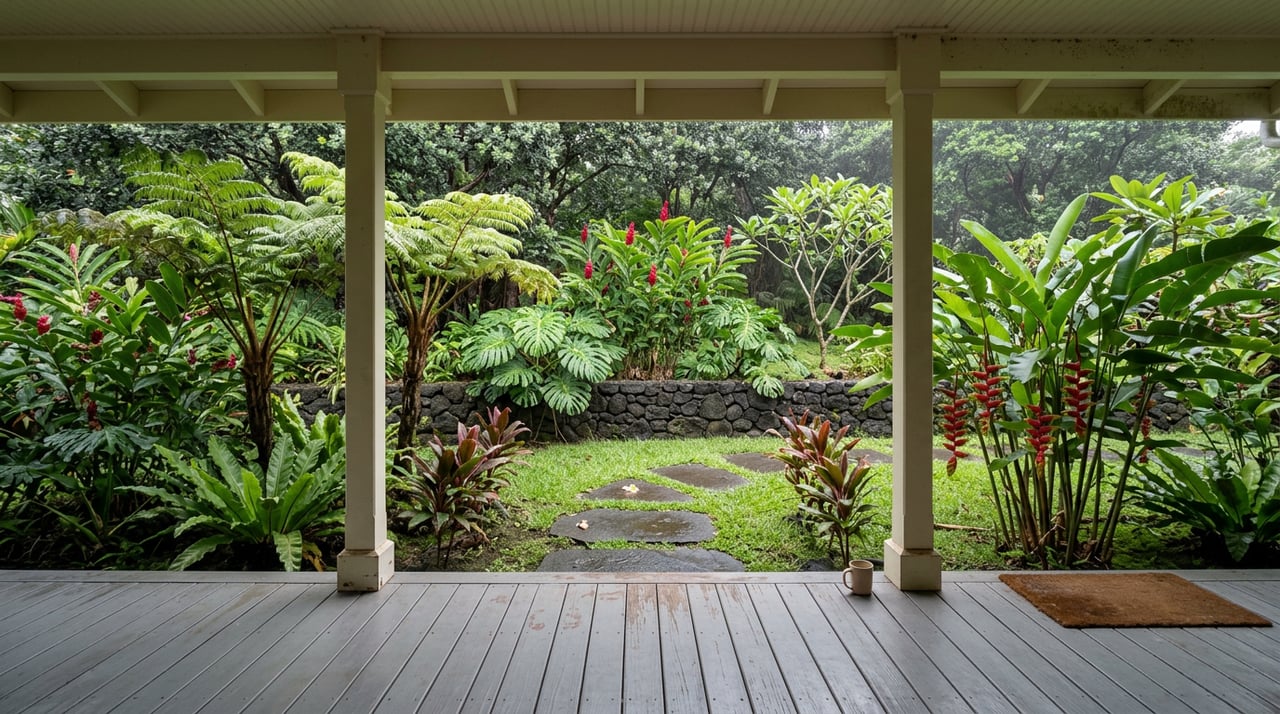
A Local's Weekend in Haiku: Two Canneries, One Rhythm
August 6, 2026
August 6, 2026
Most guides to Haiku treat it as a single dot on the North Shore map. Anyone who actually lives here knows the town runs on two old pineapple canneries, not one, and the week bends around which one you point the truck at. The Haiku Marketplace at the top of Haiku Road is the front-facing hub with the grocery store and the sushi line. The Pauwela Cannery, a few minutes up West Kuiaha, is the quieter working half where residents outnumber rental cars by a wide margin. Learning to route your Saturday between the two is the practical local skill nobody writes about.
That is the thesis of this post. Everything below is a case for it.
The central buildings at the corner of Kokomo and Haiku Roads were first constructed in 1904 as part of the Haiku Cannery, once the largest pineapple canning facility on the entire island. What sets the Marketplace apart from any other rural shopping center on Maui is that several ancillary buildings were joined together with three interconnected roofs, so all of the businesses operate in a single large indoor space. You can pick up dinner, drop off laundry, buy a garden hose, and take a Muay Thai class without stepping back into the sun. On a rainy North Shore afternoon that matters more than it sounds.
The tenant mix is the real news. Haiku Market was recently bought by Foodland and renovated, which quietly upgraded the produce section and the wine wall for people who used to drive to Pa'ia or Kahului for a decent bottle. Around it sit the places you already know by first name.
NUKA is the anchor. The izakaya-style Japanese kitchen builds its menu on what is fresh from local farmers and fishermen, and the restaurant mills its own rice and creates pickles from the byproduct of the milling process. Practically, that means the tempura and the daily fish list are not interchangeable with anywhere else in the county. It also means the line. Hours run Monday through Friday 11:30am to 10pm, with Saturday and Sunday shifted to 4:30 to 10pm, and the online waitlist opens at 5:15pm and closes at 8:45pm, which lets you add yourself remotely and watch the current wait. If you have not yet made a habit of putting your name in from the driveway before you leave the house, do that.
Colleen's at the Cannery is the counterweight. It is a hidden gem in Haiku-Pauwela offering organic New American cuisine with three hearty meals daily and a popular happy hour, and it transforms into an intimate setting at night, perfect for enjoying martinis and fresh fish dishes. Colleen's is the answer when NUKA's waitlist is already an hour and you want to sit down instead of stand.
The rest of the roof covers the everyday.
None of this is glamorous, and that is the point. The Marketplace is the neighborhood's shared living room. It works because everything you need for a normal week is under those three roofs, and the sushi happens to be some of the best on the island.
Two minutes up the mauka side of Hana Highway sits the other cannery. The Pauwela Cannery is on West Kuiaha Road in Haiku, about a two-minute drive up the mauka side of West Kuiaha just off of Hana Highway, and this Maui locale tends to be frequented more by residents but it has quite a few surprises in store for visitors. The parking lot is gravel. The signage is minimal. If the Marketplace is the front door of Haiku, Pauwela is the workshop out back.
The point of naming it here is not to inventory every tenant. It is to note that Haiku's daily rhythm actually has two centers of gravity, and if you only use one of them you are living half the town. Errand routes that dip into both, in one loop, are the ones that end with dinner instead of a second trip.
Haiku Sundays are their own category, and the Marketplace is not the whole story on the seventh day.
Temple of Peace, up in the hills above town, holds a standing invitation. Every Sunday, the Temple of Peace offers a Heart Song Celebration open to the public, and all are welcome to join in song with this interfaith spiritual community. Whether or not the singing is your speed, knowing it is on the schedule tells you something about the character of your neighbors.
For a slightly longer Sunday drive, the Hui No'eau Visual Arts Center in Makawao sits ten minutes upcountry and hosts, over the course of the year, the Art Affair, Maui Open Studios, food and wine events, and programs with world-renowned guest speakers. Locals who treat Hui No'eau as part of Haiku's cultural footprint tend to be the ones who never run out of Sunday plans.
A neighborhood post is worthless if it does not name real dates. Two are worth putting on the fridge.
The first is civic. On Tuesday, August 26, the Speed Tables Community Meeting runs 6:30 to 8:30pm at the Haiku Community Center. If you have opinions about traffic calming on your stretch of road, that is where they get heard. Meetings like this are how the shape of daily life in Haiku actually gets decided, and turnout tends to be small enough that a handful of neighbors can shift the outcome.
The second is agricultural. The Upcountry Farmers Market is the standing Saturday commitment. It runs from 7:00 to 11:00am every Saturday at the Kulamalu Town Center in Pukalani, and it favors the early shopper. The 20-minute drive up the mountain is worth it for the produce alone, and it pairs cleanly with a stop at Foodland on the way home for what the market did not have.
A few more anchors that recur through the year and reward booking in advance:
| Event | Window | Why it matters to Haiku |
|---|---|---|
| East Maui Taro Festival | April, annual | The 30th annual celebration of kalo hosts the taro pancake breakfast, poi-pounding demonstrations, cultural performances, and food booths, and the drive out to Hana is a Haiku day trip. |
| Seabury Hall Craft Fair | Day before Mother's Day | Held at 480 Olinda Road, Makawao, celebrating 50 years as a beloved Maui tradition, showcasing Maui's finest artists, jewelers, crafters, and floral designers. The closest large craft fair to Haiku. |
| Kapalua Wine & Food Festival | Late June | The 45th annual event, the oldest and most prestigious food and wine festival in the country, features four days of wine tastings, celebrity chef luncheons, seminars, winemaker dinners, and the Grand Tasting. Worth the West Side drive once a year. |
| Hawaii Food & Wine Festival | Oct 23 to 25, 2026 | Multi-island epicurean event with multiple Maui dates, including the Roy Yamaguchi Golf Classic and the World of Wagyu, Wine & Whiskey grand tasting at Sheraton Maui, hosting over 150 chefs, winemakers, and mixologists. |
None of these live inside the Haiku zip code, and that is the second half of the local skill. Haiku is a base camp. The people who love living here treat the whole North Shore and Upcountry corridor as their extended backyard.
If you want a single template to test the two-cannery idea against, run one Saturday like this. Upcountry Farmers Market by 7:30am. Back down to the Marketplace by mid-morning for the Foodland run, a stop at Fukushima's for chow fun before it sells out, and a growler refill at Maui Kombucha. Home for the middle of the day. Add your name to NUKA's waitlist from the couch around 5:15pm. Drive back down when the phone tells you the table is 20 minutes out.
You will notice that plan touches four different Marketplace tenants and one Upcountry stop, uses about a gallon of gas, and does not require a single decision made in the car. That is what people mean when they say Haiku is easy to live in.
The generic version of this post lists ten restaurants and calls it a guide. The specific version, the one that matches how residents actually spend a week here, treats the Haiku Marketplace and the Pauwela Cannery as a two-node system, layers the Sunday cultural stops on top, and pins the whole thing to the events already on the county calendar. Everything else, the tempura at NUKA, the martini shift at Colleen's, the Saturday-only chow fun, the Foodland renovation, the Heart Song at the Temple of Peace, is evidence for the same claim: this town is small, and it rewards residents who learn its two centers instead of one.
If you already live in Haiku and want a team that treats the neighborhood with the same specificity, or if you own property here and are thinking through what to do with it next, the MacArthur Team Maui has generational roots on this island and a concierge approach to every stage of ownership. Call or Text the MacArthur Team — Start Your Maui Home Search.

A Quick Read
Connect with a trusted Maui real estate team ready to guide you confidently, whether buying, selling, or exploring island opportunities tailored to your lifestyle.